Tighter weave, higher burst strength, and longer warranties cost more. Here is when a high-density mesh cover is worth the upgrade and when standard mesh is enough.
Not all mesh covers are the same, even though they look similar from a distance. The difference lies in weave density, material strength, hardware quality, and warranty length. A standard mesh cover and a high-density commercial-grade cover both meet the ASTM safety standard, but they are built for different expectations. Understanding the gap helps you decide whether the upgrade is a smart investment or an unnecessary expense for your property.
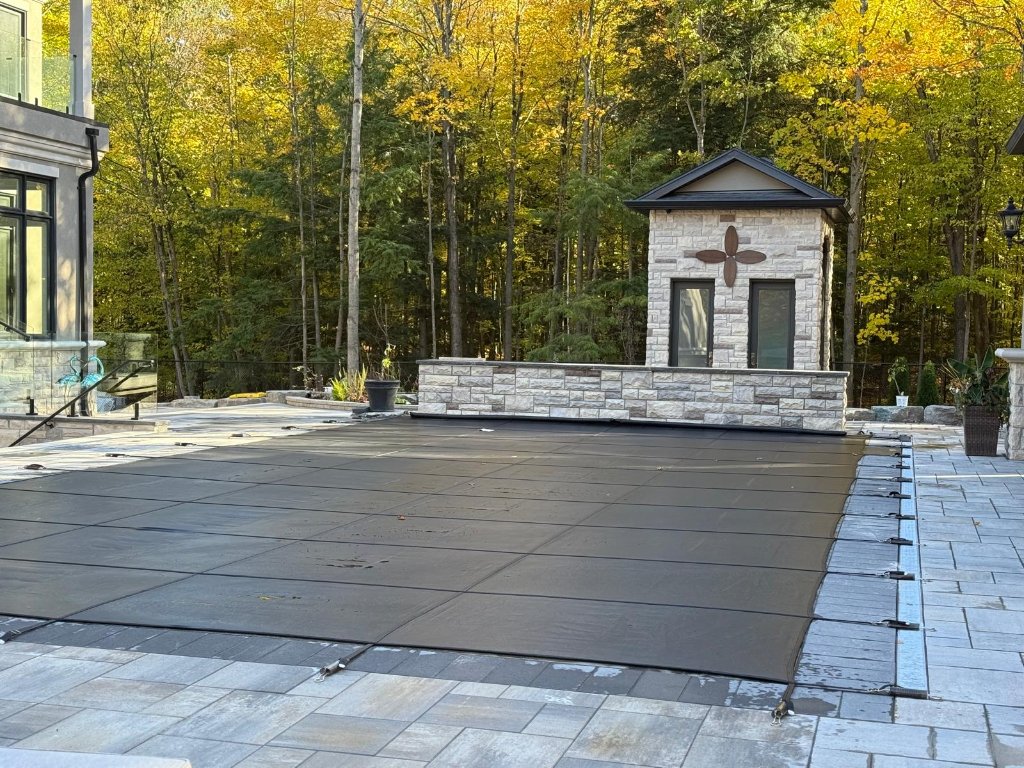
Standard mesh covers are the value option and a genuinely good product. They typically block about 95 percent of sunlight, use a moderate weave that drains freely, and carry burst strengths around 500 psi. Warranties commonly run 15 to 18 years. Covertech's Premier Mesh, for example, is rated at 500 psi with an 18-year warranty. For a pool with modest tree cover, moderate snowfall, and a homeowner who wants dependable safety at a fair price, a standard mesh cover is often the correct choice. It performs well and costs less than premium alternatives.
High-density covers use a tighter weave that blocks about 99 percent of sunlight and captures finer debris. They are built with heavier straps, stronger springs, and reinforced perimeter webbing, and burst strengths climb to 670 psi and beyond. Covertech's Deluxe Mesh reaches 670 psi with a 20-year warranty, while the Commercial Mesh achieves 760 psi with a 30-year warranty. The tighter weave means less silt and pollen working into the pool, cleaner water at opening, and better performance under wind-driven debris. The hardware is engineered to match the fabric, so the whole system is stronger.
Standard mesh is usually enough when the pool is surrounded by open lawn, receives average snowfall, and is not exposed to extreme wind. The cover will drain well, block most sunlight, and last for many years. If the budget is tight or the pool is in a mild climate, spending the difference on professional installation and a precise fit is often smarter than upgrading the fabric. A well-fitted standard cover outperforms a poorly fitted premium one, and fit is the single biggest determinant of real-world performance.
The upgrade pays when the property is demanding. Heavy deciduous trees, pine needles, nearby fields, or a windy exposure all favor a tighter weave because they reduce the amount of fine debris that reaches the water. Commercial or semi-commercial use, such as a rental property, a bed and breakfast, or a pool that hosts groups, favors the higher burst strength and longer warranty. Cold climates with heavy snow benefit from the stronger hardware and tighter construction. And owners who plan to stay in the home for decades get more value from a 30-year cover than from one they will replace twice.
Cost per year is the fairest comparison. A standard mesh cover at $1,500 over 18 years costs about $83 per year. A high-density cover at $2,800 over 25 years costs about $112 per year. The premium is roughly $30 per year for a tighter weave, stronger hardware, cleaner water, and fewer replacements. When you factor in reduced spring cleanup, less chemical use, and the avoided cost of an earlier replacement, the high-density option frequently closes the gap entirely. The question is not which is cheaper today, but which costs less over the life of the pool.
Beyond weave density, compare the details that determine longevity: strap width and spacing, spring quality, anchor material, seam construction, and the clarity of the warranty. A warranty that excludes labor or prorates heavily is less valuable than one that stands behind the product. Ask how the cover is measured and whether the installer uses a laser or manual system. Ask what happens if a strap fails in year ten. The answers separate a premium product from a premium price tag, and they matter more than marketing language.
For most residential owners with average conditions, standard mesh is a sound, economical choice. For wooded properties, harsh climates, commercial use, or long ownership horizons, high-density mesh is the better investment. Either way, buy based on measured fit, certified hardware, and a warranty you understand. The cover that protects your pool for decades is rarely the cheapest one on the quote, but it is almost always the one with the lowest cost per year and the fewest surprises.
Evaluate the weave and materials directly rather than relying on labels. A tighter, denser weave blocks more sunlight and fine debris, but it must still drain freely; if water beads on the surface, it is not mesh as intended. Look at the strap width and spacing, the quality of the stitching, and the type of springs and anchors. Ask for the burst strength in psi, the sun-block percentage, and the warranty terms in writing. Compare samples side by side if possible. A reputable manufacturer will gladly explain the differences, and a confident installer will stand behind the specification rather than deflecting the question.
For most pools, the right answer is the cover that matches your conditions and your horizon. If you plan to move in a few years and your property is open and mild, standard mesh is sensible. If you have trees, snow, wind, or a long ownership horizon, high-density mesh pays back through durability and cleaner openings. Either way, invest in accurate measurement and professional installation, because those determine performance more than the last few percent of weave density. Buy the best fit you can afford, maintain it properly, and the cover will protect the pool and the people around it for many years.
One last practical tip: keep the original invoice and warranty certificate with your pool records. If a strap or seam fails, the warranty claim is far easier when you can show the purchase date, the installer, and the specification. Photograph the cover before and after each season, and note any repairs. A well-documented cover is also easier to transfer to a buyer if you sell the home. These small records protect your investment and make future service simpler, whether you stay in the property or move on.